- See more at: http://www.bloggerhow.com/2012/07/implement-twitter-cards-blogger-blogspot.html/#sthash.DO2JBejM.dpuf
Showing posts with label safety. Show all posts

Friday, November 6, 2020

Bad Markings

This shared-use path becomes precariously narrow on the bridge over the Bronx River. It is barely wide enough to comfortably ride; forget trying to pass anybody else. The thing is, there is some residual roadway space that could be repurposed to fix this problem.

The path drops from a full 14-feet-wide shared-use path
right at the bridge

Monday, May 4, 2020

Not-So-Safe Streets

During the current global pandemic, there has been a precipitous drop in driving. Traffic has all but evaporated on New York City's streets. Meanwhile, sidewalks and parks are not providing enough space for people to walk for essential trips, including some basic exercise. Repurposing the residual street space for walking is an obvious solution, and one that is increasingly pursued in cities around the world. New York has been slow to follow, with the Mayor resisting the very idea until continuing to refuse to open streets became politically untenable. Under order of the Governor to do something, he initially opened a few random streets and posted lots of police officers on every block. Shortly thereafter, he pulled it, claiming the police costs were too high.

Public and political pressure continued to mount, expecially as examples continued to come in from other cities. Photo after photo of from other cities closing streets with simple barriers without a heavy police presence made it untenable to continue insisting that New York City was so unique that we could not open our streets too. Finally, another small number of short street segments were announced for an initial opening this past weekend.
The first day at the Oval only had a small hiccup. The barriers were placed at Reservoir Oval itself, stopping traffic after it had turned onto the inlet streets, with no good way to turn back around. When the street openings were announced with their mileages, I wondered why DOT had not taken credit for the additional mileage from those side streets. The day before the street opened, my 8-year-old son was even thinking out loud on his own about where the barriers would need to be placed for these streets. Just a couple hours after the Safe Street opening, the NYPD recognized and corrected the situation by bringing out additional barriers to intercept the drivers before turning onto those streets. Still, it was an inexplicable mistake for professionals to make.

Saturday, November 2, 2019

An Alleyway and the Joker Stairs


In a dank alleyway, far beneath the metropolitan skyscrapers, there exists a temporal loop. A rich couple, having taken an ill-advised shortcut from the theatre to reality, are shot dead over and over, each time in slightly different variations but always with the same outcome.
Darran Anderson, Imaginary Cities

On Halloween, I watched the new Joker movie at a cinema in The Bronx. There has been a lot of discussion locally about the influx of tourists to "the Joker stairs," but as an urban planner, I would have been scrutinizing the details of the newest version of Gotham City anyway. As I noted in a review of Imaginary Citiesthe variations of Gotham over time show changes in the fears lurking in the dark places of our collective consciousness.

Joker almost entirely abandons any effort at developing a fictional Gotham City. With almost no alterations, it is unmistakably New York City. More precisely, it is the mythos of the "bad old days" of New York in the 1970s and 80s, complete with the 1981 garbage strike. Stylistically, it draws visual and acting cues from Scorsese's Taxi Driver (1976), a reference that is directly reinforced by Robert De Niro's character in the film. The details in the streetscape that were altered to recreate the appearance of New York in 1981, and even those that were missed, can be informative. The tagging on the subway and the porn titles on the theater marquees (channeling the Times Square's era of infamy) keep the sense of disorder palpable. Choosing this period was an effective way to capture the grit that has always defined Gotham in the comics and movies, something that has become more difficult as cities have been largely rebuilt into glossier places that are much safer. More importantly, it captures current anxieties about going back to the "bad old days."

The only significant real fictional change to New York's built form in this movie was the insertion of an alley into the old Deuce. Although it appears much of this may actually have been filmed at locations in Jersey City and Newark (places where commercial strips have not been as extensively redeveloped), there is no doubt this was a recreation of 42nd Street in the Time Square area. New York is not a city of alleyways, but the filmmakers revised the infamous streetscape of porn theaters to include one. As usual in dark urban fiction, an alley is a residual space where garbage collects and the retreating effects of society no longer reach. The opening sequence of the movie concludes in this lawless Gotham locale; we see the violent nature of this city as we get to know Arthur Fleck as a helpless victim before he transforms into the Joker. It is this attack that sets in motion the series of events that send Arthur spiraling out of control.
Arthur Fleck lying in the alley after he was attacked

Sunday, September 22, 2019

Barriers Against What?

There have been dire warnings recently that car manufacturers might try to exert their influence to take over city streets at the expense of pedestrians (again). A recent flare up followed the suggestion that some executives were considering the installation of gates at intersections to keep pedestrians from crossing against the light and interfering with autonomous vehicles. The backlash from urbanists was immediate: We should not repeat the mistakes of the past when cars were first introduced into cities. People should not be penned in on the sidewalks like cattle. Etc.

A couple of examples:

Caution is warranted, of course. The ability of autonomous cars to successfully navigate dense pedestrian areas is dubious, and some of the materials released by the auto industry have been outright frightening (see below). I agree with the need to be vigilant about the policies that may redesign our cities very quickly, setting new patterns that may hold for generations to come. In this case, though, it seems like a knee jerk response of the "if it's good for cars, it must be bad for pedestrians" variety. The idea surfaced, after all, as a solution to the potential problem of pedestrians interfering with the automated vehicles, which might become paralyzed if people deliberately walk in front of them, knowing that safety procedures designed to avoid injuring people will make them stop.


Nonetheless, I am fairly optimistic that automated vehicles can be leveraged to transform the places we live for the better, and I see crossing gates as an acceptable tradeoff. Likely enough, they could become a welcome addition to our streetscape.

Saturday, April 7, 2018

Chronicles of Stolen Space: Fake Enforcement

After closing the Privately-Owned Public Space for months of reconstruction to fix subsurface problems, the Millennium Hilton is now reopening its POPS with the same non-compliant design and illegal operations that degrade our public realm. And as before, despite some pretense that they are responding to complaints, the enforcement agencies empowered and entrusted to safeguard our public space are allowing the owners to shirk their responsibilities and steal space from the public:
  • Required public seating and other features were not installed
  • The parking garage has resumed using an area that is supposed to be public seating to temporarily park vehicles
  • The parking garage continues to illegally encroach on the sidewalk and park an extra vehicle that blocks an egress door.
The Department of Buildings, after an insanely prolonged battle, did finally issue a violation for the missing public space amenities. That turned out that was only a token gesture. They listed a demerit and issued a small one-time fine. Then they let the building's owners continue with business as usual. If the Department of Buildings were serious, they would require the owners to meet their obligations under the Special Permit or revoke their Certificate of Occupancy. By all appearances, the Department of Buildings is still siding with unscrupulous building owners against the public.


Meanwhile, the New York Police Department is still letting the parking garage operator break the law and possibly endanger lives. In response to 311 complaints, they have claimed to go out in an attempt to take care of the problem, but those responses are obvious falsifications.

The result is a poor pedestrian experience for the city's residents, workers, and visitors due to wealthy business owners abusing our public space and possibly even putting the lives of their own paying guests in danger.

Previous chronicles in this saga:
http://urbanresidue.blogspot.com/2016/09/chronicles-of-stolen-space-new-york.html


Monday, January 1, 2018

Under the Roadway - Inspiration from Bethesda Terrace

It seems to be an article of faith among many contemporary planners that grade separation is an
ti-pedestrian and inherently anti-urban. In practice, this has been the case all too often; pedestrians have been forced to use uncomfortable overpasses and underpasses, diverted from a direct route to a grossly inferior detour. It is indeed a miserable experience when you're forced to climb steep stairs to walk across a narrow concrete pad over noisy traffic with a sharp wind cutting through the chain link fence, or to pass through a claustrophobic, musty, tunnel adorned solely by the exposed electrical conduit for the dim lights. Yet when we accept these bad places as our model for grade separation, we forget the concept's original vision and early success. This troubles me again each time I visit Central Park.


The ideas and work of Frederick Law Olmsted set much of the foundation for urban planning. His transverse roads in Central Park continue to successfully overlay a rustic park environment on a busy street grid. They make it possible for an expansive urban park to coexist with the city's street system. This is the baby we should not throw out with the bathwater.

And then there's Bethesda Terrace, the architectural showpiece of the park. It is an amazing progression of space, a place that is experienced by movement through a sequence of spaces. Grade separation here is not some mere functional layout. It is not just a safety feature. The experience of descending, the transition through a dark, constrained space that frames the view of the Angel of the Waters, and the reemergence into the open, sunny space is the design.

Monday, June 27, 2016

Angry Mobs

Yesterday evening, there was a loud bang outside our house. By the time my wife made it to the window, several cars were crashed and shouting people were surrounding one of the cars.

By the time I got down the steps, somebody had taken the keys from the driver. A shattered mess of debris had sprayed outward from the crash site. The passenger-side window was broken where a young man smashed it with his fist. It was immediately clear the driver was drunk. 

The drunk driver's car had come to a stop in front of our house, where it had destroyed the back of a double-parked car and crumpled it into a car parked in front of it. Another car with its driver-side mirror was parked behind it. The crowd growing around the car yelled about other cars the driver hit careening from one side to the other as he smashed his way down the street.

A boy and others from the corner showed up with a bent bicycle. Apparently he jumped off before the car crushed his bike down at the intersection.

People were growing increasingly angry. Another driver in particular was ready to drag the drunk out into the street for a public beating. He claimed to own the first car that was struck, and said he had followed the driver all the way from Westchester County, witnessing six or seven collisions along the way. It seemed like an overreaction for a broken mirror, although it was clearly infused with indignation over the state of the driver putting lives at risk on the road. Some of my neighbors were growing angrier as talk swirled about how easily he could have hit a child. The car he crushed where he came to a stop had a child seat in the back (but thankfully no child inside).

Tuesday, January 19, 2016

Is There a "One-Way Epidemic"?

Recently, City Limits ran an op-ed by architect John Massengale about the need for safer street design. Under the photo at the top, the caption read: "First Avenue in Manhattan. Avenues used to run two-way, which is safer for pedestrians, but were mostly made one-way, to make life easier for drivers." This argument was elaborated in detail in the text. This week, Cap'n Transit followed up on his blog, extending the campaign against one-way streets.

These are familiar arguments. After beginning a discussion a while ago about one-way streets, it was suggested that I refer to "The One-Way Epidemic" section in Walkable City, which makes these same claims. These pieces all serve as good examples for discussion purposes. I wholeheartedly agree with the need to redesign New York City's streets to be safer for pedestrians, and I share the majority of the views of these safe-street advocates. I find some areas of common ground regarding one-way streets, as well, but it is useful to draw out the key differences as well as the overlap to illustrate why the rhetoric against one-way streets is overblown and counterproductive.

Let's start with the term "epidemic" used in Walkable City. This is rhetoric that invokes fear. The book explicitly compares the creation of one-way streets with an outbreak of influenza that killed 20 million people in 1918-1919. The not-so-subtle claim is that one-way streets are an imminent threat to your life. Avoid them like the plague!

Sunday, March 22, 2015

The Tremont Crash Zone

A passenger waits for the bus at a stop where the sign has
been wiped out by an out-of-control vehicle. Apparently
crashes are so common here, extra protection has been
added around the posts for the traffic signals
When New York City reduced the citywide speed limit from 30 to 25 mph, some arterial streets kept the higher speed limits. Among those was a portion of East Tremont Avenue. On recent visits, it looks like an outright crash zone. An entire stretch of the street east of Morris Park Avenue has been rendered a sprawling residual space by the combined impacts of out-of-control cars, shallow properties bordering the railroad, and the proliferation of auto-related land uses. Given the conditions confronting pedestrians, the speed limit warrants a revisit.
This sign encourages higher speeds 
when driving past the bus stop

Wednesday, November 12, 2014

Filling the Void, Maintaining Sight Lines

When cars park too close to the corner, drivers and pedestrians often cannot see each other well enough to make safe decisions. To correct the problem, parking is frequently prohibited near intersections to improve sight lines, a practice sometimes referred to as "daylighting." Nevertheless, regulations cannot actually prevent the hazardous conditions from continuing. The public and even some enforcement agencies seem to have a low level of awareness or appreciation for the need to keep these locations clear, and the residual nature of these spaces continues to be problematic.


In an effort to improve the situation, enhanced markings are often used to reinforce the regulatory signage. Even with this effort to emphasize the regulations and create some illusion of occupancy, the space continues to feel unused. In an active urban environment, a space marked off for the sole purpose of a sight line really is, in practice, underutilized. The demand to make more intense use of it is probably inevitable.

The solution to these residual spaces is to provide them with uses that do not compromise the sight lines. To be effective and persuasive enough to continue installing them elsewhere, treatments must embrace uses that are appealing to the community.

The classic response is to install a curb extension, sometimes called a "neckdown." These rely on the curb as a physical barrier that effectively discourages parking. They also provide benefits for traffic calming and shortening crossing distances for pedestrians. A curb extension is an expansion of the sidewalk, creating more usable space for pedestrians, although they may recognize relatively little value in the extra panels of concrete. This solution is often complicated, though, by mundane engineering details like drainage or even traffic signal location. Capital costs can discourage or delay construction.

Wednesday, August 27, 2014

Real Poor Doors

There has been a lot of discussion about the "poor door" scandal in New York City. The New York Times covered it in depth yesterday. Some developers taking advantage of affordable housing incentives have been segregating their below-market units from the more affluent residents with separate entrances.

As insulting and socially destructive as that is, this whole discussion does not do justice to the housing challenges of New York City's poor. The "affordable" units in the new buildings are still positioned at incomes around the city's median household income. This is not housing that is within reach of the poor.  This fact provides some support to the push back against the critics of this practice; many people just aren't that sympathetic to the insult to residents who could afford a typical apartment but have won the opportunity to move into a much nicer unit because they happened to win a lottery.

This situation is typical of the public discourse around affordable housing in New York City. There is attention and programs for the middle-class, with public debates back and forth about how much support professional workers really need and deserve. Meanwhile, the units that are inhabited by the working poor, who spend so much of their earnings to inhabit apartments with much worse conditions than new construction with a side entrance, are places that remain invisible to public discourse.


The poor have always inhabited the residual spaces of the middle class. Sometimes these were neighborhoods of speculative middle-class housing that were left over from a glut of  housing bubble,  ultimately becoming crowded ghettos as the houses were chopped up into apartments. Other times, and increasingly in New York City today, it is extra space in one- and two-family houses in neighborhoods where the working class moved in after the original middle-class owners moved on. These less affluent owners often can no longer afford the entire space for themselves as they struggle to pay the mortgage and maintenance on the structure. Many turn to renting out rooms for supplemental income. These are the illegal apartments that fill basements and cellars, and dangerously partition floors in houses throughout the city's sprawling residential districts.

Saturday, July 26, 2014

Where Is the Plaza at Bay Plaza?

My family ends up out at the Bay Plaza shopping center in Co-Op City on a somewhat regular basis. Cinemas are becoming few and far between in The Bronx, and the AMC at Bay Plaza is one of our best options for a date at the movies. Despite all the drawbacks of the sprawling strip mall environment, it also remains one of our more convenient shopping alternatives for some needs. Like many others who frequent Bay Plaza, we get there by bus.


Unfortunately, the good money spent on bad design in Bay Plaza does not create a positive sense of place. It just makes transit passengers and the pedestrians from Co-op City feel second class. It makes the place less attractive and functionally inferior for shoppers who arrive by car as well.

There is no coherent network for internal pedestrian circulation.  Everything has been designed to move cars in and out of the parking lots, resulting in sidewalks that are narrow and often disconnected, as well as poorly designed crosswalks.  The transit stops have been dropped in as an afterthought, and are further challenged by their location on private property. Even for those who drive, getting between stores, restaurants, and entertainment is not particularly pleasant. Bay Plaza has put some attention into its landscape architecture in recent years (although there is room for great improvement for stormwater management with the endless acres of pavement!), but what it actually needs is an urban designer.

Nice landscaping.
Where's the sidewalk?

Friday, July 4, 2014

Conflicted Crosswalks: Hudson St and Christopher Columbus Dr

The intersection of Hudson Street and Christopher Columbus Drive in Jersey City has real potential to someday become a great public space at a lively, multimodal intersection. For now, it is a fragmented set of residual spaces with a traffic design that is inconvenient and uncomfortable for pedestrians and bus passengers. This is a case where excess concern about pedestrian-vehicle conflicts, combined with decisions to prioritize motor vehicles and a failure to realize that vehicular volumes never materialized, has resulted in a compromised pedestrian network that simply does not work properly. Let's look at how we can put it on a path toward realizing its potential.


This irregular intersection has only modest conflicts between pedestrians and vehicles. That is largely because the vehicular volumes are really quite light. Nevertheless, at this set of intersecting roadways, pedestrians are instructed to follow an extraordinary detour across several different crossings to avoid the potential conflicts with turning vehicles. To further the inconvenience, one of the crosswalks on that detour route has an unusually short pedestrian signal time.

This poor treatment of all the pedestrians who walk through the area is unnecessary, and it sets the wrong priorities by favoring motor vehicles. The whole confluence of intersecting streets should be reevaluated, and in the process it should be possible to create a whole new public space.

The crazy detour really is unnecessary. The conflict this whole situation was designed to avoid is so minor, it really seems unusual that the crossing was prohibited at all. Typical intersections throughout Jersey City and just about everywhere else have worse turning conflicts than this. With a close review of the signage that has been installed, the motivation can be discerned, but the aspect of the design that raised the concern is not only unnecessary, it creates a risk of vehicular collisions.

The pedestrian crossing is prohibited at this location because southbound Hudson Street has two right turn lanes.

The vehicles turning from the second lane would pose a real threat to pedestrians crossing the street, so in an attempt to maintain safe conditions for the pedestrians, the engineers attempted to remove them from the mix.

Despite the efforts of the engineers, the pedestrians who frequent this location exert their independence and continue to cross illicitly. By and large, they have little difficulty. Nevertheless, the apparent conflicts should be resolved, and can be resolved in a way that is much more satisfactory.

Sunday, June 29, 2014

The Wilderness

New York City Nature Preserves


By the time we can speak of preserving and protecting wilderness, it has already lost much of its meaning: for example, the Biblical meaning of awe and threat and the sense of sublimity far greater than the world of man and unencompassable by him.
"Wilderness" is now a symbol of the orderly process of nature.  As a state of the mind, true wilderness exists only in the great sprawling cities.
- Yi-Fu Tuan, Topophilia 


Sunday, June 1, 2014

Legally Blocking the Crosswalk?


The first question on anybody's mind is surely: What kind of jerk parks in the crosswalk?


The more important question is: Why would New York City, a place that relies so heavily on walking, enact regulations to make it legal?

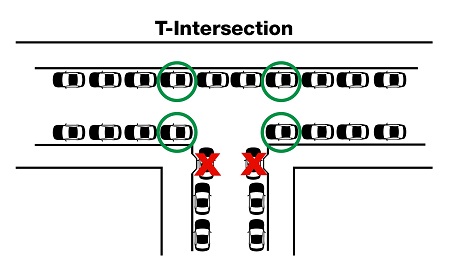
In 2008, the New York City Department of Transportation (NYC DOT) quietly changed the parking rules to allow drivers to block unmarked crosswalks at T-intersections.

According to the New York City Department of Transportation
it is legal to park in the locations indicated with red circles.
Source: NYC DOT

Saturday, May 24, 2014

Conflicted Crosswalks: The Grand Concourse


You know it's bad when they put up the You're-gonna-die signage.


Getting across the Grand Concourse in one piece can be a challenge. The combination of long crossing distances and multiple conflicting movements from split side streets gives turning drivers seemingly endless possibilities to take a shot at you. And virtually every car on the cross streets are turning (through traffic bypasses the intersection by passing below the Grand Concourse).

Even with the challenging physical conditions presented by these intersections, there seem to be some easy improvements that might help pedestrians. High-visibility crosswalk markings are one example. There may be opportunities to make the yield signage more visible to motorists and locate it to better influence behavior before drivers make their decisions. The signal timing should also be reviewed to give pedestrians a head start.

Sunday, April 13, 2014

Old Institutions Need New Vision

This is not the type of intersection you want to cross with your children to go to the zoo:

It's not really the type of intersection you would ever want to cross to go anywhere. It's too wide, and has too many fast-moving cars making turns through the crosswalk while you're trying to get across.

Of course, there is nothing much unusual about this type of intersection. This has been a fairly standard approach to designing major streets all across the continent for decades.

What is remarkable is that much of the section of Fordham Road/Pelham Parkway that begins at this intersection was just recently reconstructed here in New York City, where the Department of Transportation has earned an international reputation for its innovative street designs. Sometimes the old highway mentality can be persistent, even in transportation departments that are at the forefront of change.

This vast and expensive reconstruction also exposes the outdated views of the major cultural institutions in The Bronx. The project was initiated and moved to the top of the City's priority list by the "Four Bronx Institutions." With their drive and input, the project completely rebuilt the frontage between the Bronx Zoo and the New York Botanical Garden, two of the four member institutions, so it really demonstrates the vision they have for their patrons and employees, the surrounding neighborhoods, and each other. That vision belongs in the dustbin of the past, but I am afraid we will be forced to live with this new construction  long into the future.

Saturday, April 5, 2014

Connecting Neighborhoods Across Mosholu Parkway

Mosholu Parkway is a great shared civic space between the Bedford Park and Norwood neighborhoods. One of the aspects that first impressed me about this area was the groups of older men who walk together and talk on the parkway. Yet while the parkway is a place where the community comes together, it also acts as an inconvenience for movement between the neighborhoods.


There are some long stretches on Mosholu Parkway between intersections, which are the only locations where pedestrians may legally cross the roadways. At several of the intersections, pedestrians are confronted with regulatory signs prohibiting them from crossing at certain corners, imposing yet more limitations on their ability to get around easily.

These locations where pedestrians are prohibited from crossing should be changed. Prioritizing the turning movements of drivers cutting through the community over the residents walking between neighborhoods is the wrong choice. At these locations, the prohibitions appear to do very little to benefit the drivers anyway. The volumes of turning vehicles and pedestrians appear modest enough that allowing pedestrians to go where they want should not create any real problems with turning delays.

Monday, March 17, 2014

Conflicted Crosswalks: Washington St. and Columbus Dr. in Jersey City

This is the second in a series of posts about crosswalks with conflicts that threaten pedestrians. These are intersections located in neighborhoods that are not living up to their full potential, due in large part to traffic that is hostile to walking. As they exist today, these street corners are not neighborhood places; they are merely the residual space where flows of vehicular traffic collide. Each intersection has its own unique problems, but looking at several cases will help to identify some commonalities. This time we look at Washington Street and Columbus Drive in Jersey City.

One of my colleagues was complaining to me about drivers failing to yield to pedestrians in a crosswalk near our office. He was particularly concerned that the traffic controls were giving left-turning drivers a left arrow at the same time pedestrians had a walk signal. This clearly creates a conflict (which concerns me even more for nighttime operations, given reduced visibility and the likelihood of impaired pedestrians leaving the bar on the corner crossing the street en route to the light-rail station or a bus stop).


My colleague and I both had an initial thought that this signal sequence would be prohibited by engineering standards. Yet when my colleague looked it up in the Manual on Uniform Traffic Control Devices (MUTCD), it appears it is actually allowed:


Section 4D.04 Meaning of Vehicular Signal Indications


...1. Vehicular traffic facing a GREEN ARROW signal indication, displayed alone or in combination with another signal indication, is permitted to cautiously enter the intersection only to make the movement indicated by such arrow, or such other movement as is permitted by other signal indications displayed at the same time.Such vehicular traffic, including vehicles turning right or left or making a U-turn movement, shall yield the right-of-way to:
  1. Pedestrians lawfully within an associated crosswalk, and
  1. Other vehicles lawfully within the intersection...
...3. Pedestrians facing a GREEN ARROW signal indication, unless otherwise directed by a pedestrian signal indication or other traffic control device, shall not cross the roadway.

Tuesday, March 11, 2014

Driving Truck

This was my grandfather's truck.

I found this polaroid in a box of my grandmother's mementos after her funeral. It was included along with old letters, family photographs from 1905, snapshots of weddings and newborn great-grandchildren, my high school graduation announcement. 

My grandfather held many working-class jobs throughout his life. He worked primarily as a steamfitter, but he also spent his time as a truck driver. The truck took him away from home, and it took some of his hearing too. It paid the bills and put food on the table for his children back home. It was a way to earn a living, but in some ways it was more. In a way, it was a source of pride.

For a short man with little education, skilled labor was a way to stand out. It takes skill to become a steamfitter, and my grandfather stood out. Because of the quality of his work, he completed delicate projects like nuclear power plants. 

While it seems more mundane, more commonplace, driving truck requires skill too. Owners don't just entrust their investment in an expensive vehicle to anybody. Businesses that need their deliveries to arrive on-time and undamaged need some confidence in their transportation.