On Mosholu Parkway, below the side of Jerome Avenue, in the shadow of the elevated 4 train, there stands an abandoned comfort station that has poor prospects as public restrooms due to a site that has low foot traffic and limited visibility. The roof and odd yard beside it are frequent victims of dumping. Much of the building is sealed, but one of the restrooms is enclosed with an open-air gate. The space appears to be secured for use as storage, although there is no evidence anything has been stored here for quite some time.
Showing posts with label Mosholu Parkway. Show all posts
Showing posts with label Mosholu Parkway. Show all posts
Saturday, December 17, 2016
Dreams for Abandoned Bathrooms
New York City has a general lack of public restrooms. Our public space was not always so harsh; parks were once much more generously equipped with comfort stations. Many of them became unfortunate casualties of hard times and crime decades ago, and their public service has been slow to return as the City's fortunes have improved. While many of them should be returned to public use, or replaced with modern facilities, to meet public needs, some of them were poorly planned and located in areas with little activity.
On Mosholu Parkway, below the side of Jerome Avenue, in the shadow of the elevated 4 train, there stands an abandoned comfort station that has poor prospects as public restrooms due to a site that has low foot traffic and limited visibility. The roof and odd yard beside it are frequent victims of dumping. Much of the building is sealed, but one of the restrooms is enclosed with an open-air gate. The space appears to be secured for use as storage, although there is no evidence anything has been stored here for quite some time.
On Mosholu Parkway, below the side of Jerome Avenue, in the shadow of the elevated 4 train, there stands an abandoned comfort station that has poor prospects as public restrooms due to a site that has low foot traffic and limited visibility. The roof and odd yard beside it are frequent victims of dumping. Much of the building is sealed, but one of the restrooms is enclosed with an open-air gate. The space appears to be secured for use as storage, although there is no evidence anything has been stored here for quite some time.

Monday, February 9, 2015
Stolen Space and Leftover Space
The 52nd Precinct steals space from the community every single day. The inconvenience and the perception that the police lack respect for the law create an ongoing source of tension with the community the NYPD is supposed to serve. A review of the conditions surrounding the precinct demonstrates that parking could, in fact, be managed satisfactorily with a little professional attention and a basic level of discipline. The parking is, in fact, illegal, and the NYPD has an obligation to restore order both to maintain its own integrity and to relieve the burden on the community that hosts the station house.
Unlike many station houses in New York City, the 52nd Precinct has its own off-street parking lot. This is not a cheap piece of infrastructure, either, since it is largely on a deck over the MetroNorth Railroad. Additional exclusive parking has been created with parking regulations that dedicate the curb lane on the east side of Webster Avenue to the precinct. Yet this is not enough to keep the East Coast Greenway clear of parked cars.
Over the years, every commanding officer and the Community Relations officers have consistently said they plan to repave and stripe the parking lot to increase the amount of parking by reducing the space generally lost to an inefficient ad hoc layout, as well as drivers supposedly trying to avoid mud puddles. Yet after years, there has been no change. The only maintenance ever performed on the lot is to periodically fix the fence posts when drivers have damaged it again (a sign that is not particularly encouraging about the driving abilities of the officers who cruise the neighborhood all day long).
Unlike many station houses in New York City, the 52nd Precinct has its own off-street parking lot. This is not a cheap piece of infrastructure, either, since it is largely on a deck over the MetroNorth Railroad. Additional exclusive parking has been created with parking regulations that dedicate the curb lane on the east side of Webster Avenue to the precinct. Yet this is not enough to keep the East Coast Greenway clear of parked cars.
 |
| These cars are parked on a shared-use path that is part of the East Coast Greenway |
Saturday, April 5, 2014
Connecting Neighborhoods Across Mosholu Parkway
Mosholu Parkway is a great shared civic space between the Bedford Park and Norwood neighborhoods. One of the aspects that first impressed me about this area was the groups of older men who walk together and talk on the parkway. Yet while the parkway is a place where the community comes together, it also acts as an inconvenience for movement between the neighborhoods.

There are some long stretches on Mosholu Parkway between intersections, which are the only locations where pedestrians may legally cross the roadways. At several of the intersections, pedestrians are confronted with regulatory signs prohibiting them from crossing at certain corners, imposing yet more limitations on their ability to get around easily.
These locations where pedestrians are prohibited from crossing should be changed. Prioritizing the turning movements of drivers cutting through the community over the residents walking between neighborhoods is the wrong choice. At these locations, the prohibitions appear to do very little to benefit the drivers anyway. The volumes of turning vehicles and pedestrians appear modest enough that allowing pedestrians to go where they want should not create any real problems with turning delays.
There are some long stretches on Mosholu Parkway between intersections, which are the only locations where pedestrians may legally cross the roadways. At several of the intersections, pedestrians are confronted with regulatory signs prohibiting them from crossing at certain corners, imposing yet more limitations on their ability to get around easily.
These locations where pedestrians are prohibited from crossing should be changed. Prioritizing the turning movements of drivers cutting through the community over the residents walking between neighborhoods is the wrong choice. At these locations, the prohibitions appear to do very little to benefit the drivers anyway. The volumes of turning vehicles and pedestrians appear modest enough that allowing pedestrians to go where they want should not create any real problems with turning delays.
Tuesday, February 4, 2014
Taming Traffic on Mosholu Parkway
Mosholu Parkway is the edge between Norwood and Bedford Park. It is a wonderful greenspace, and it's socially active. Nevertheless, the traffic divides the neighborhoods and is always a source of concern for the residents who cross it. The parkway could become a safer and more enjoyable unifying feature for our neighborhoods if we just tamed the traffic. We can do this by reducing the speed limit and by redesigning the roadway to calm traffic while improving the landscape.
Let's start with the speed limit. While the citywide speed limit in New York City is 30 mph, on Mosholu Parkway it has been increased to 35 mph. I know 5 mph may not sound like much, it makes a huge difference. At faster speeds, it is more likely a driver will hit something, or somebody. That is because their ability to perceive pedestrians is lower, they have less control over the vehicle, and they need more distance to stop. Going 35 instead of 30 mph, a car can take an extra 50 feet to come to a stop.
View Larger Map
The risk of pedestrian injuries and death increases rapidly as speeds exceed 20 mph (that is why advocates are currently campaigning to reduce the citywide limit). A pedestrian hit at 35 mph is about two times as likely to die as a person struck by a vehicle going 30 mph.
Let's start with the speed limit. While the citywide speed limit in New York City is 30 mph, on Mosholu Parkway it has been increased to 35 mph. I know 5 mph may not sound like much, it makes a huge difference. At faster speeds, it is more likely a driver will hit something, or somebody. That is because their ability to perceive pedestrians is lower, they have less control over the vehicle, and they need more distance to stop. Going 35 instead of 30 mph, a car can take an extra 50 feet to come to a stop.
View Larger Map
The risk of pedestrian injuries and death increases rapidly as speeds exceed 20 mph (that is why advocates are currently campaigning to reduce the citywide limit). A pedestrian hit at 35 mph is about two times as likely to die as a person struck by a vehicle going 30 mph.
Thursday, January 23, 2014
Daylighting Mill Brook on Mosholu Parkway
On Mosholu Parkway, we have spent decades fighting the natural topography. It is time for us to surrender and create a new alliance with the storm water.
There was once a stream on Mosholu Parkway. It was the headwater of a waterway called Mill Brook, which ran down its own little vale parallel to the Bronx River in the vicinity of Webster Avenue until it emptied near the confluence of the Harlem and East Rivers.
From NYPL:
http://
Mill Brook is long gone. At a point lost to historical memory, its full length was diverted into underground sewers. The motivation for this radical reengineering of the landscape is unclear; perhaps washing horse manure into an open stream created foul odors better diverted to the sewers. Whatever improvement was intended and perhaps achieved has now outlived its usefulness.
The stream feeds a combined sewer overflow, which results in raw sewage pouring into the waterways during heavy rains. Meanwhile, the topography on the parkway still drains toward the center. The water wants to carve out a stream bed. The result is muddy erosion in the lawns that dries into dustbowls.
Instead of letting the rain wash out the landscape while we pollute the waterfront, we should redesign the parkway as a thriving ecosystem, a piece of vital green infrastructure. In addition to reducing the overflow of sewage, daylighting Mill Brook can create a more enjoyable landscape with better amenities. It would, in fact, restore the original vision for Mosholu Parkway:
There was once a stream on Mosholu Parkway. It was the headwater of a waterway called Mill Brook, which ran down its own little vale parallel to the Bronx River in the vicinity of Webster Avenue until it emptied near the confluence of the Harlem and East Rivers.
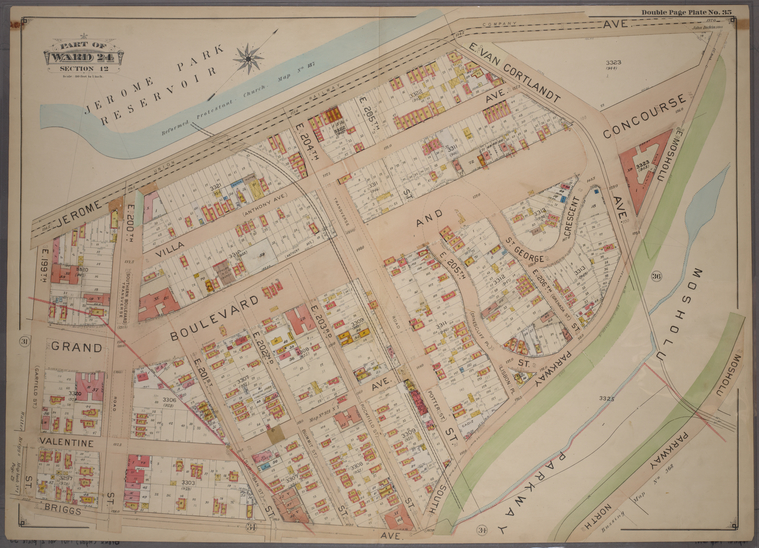 |
| Double Page Plate No. 35, Part of Ward 24, Section 12. [Bounded by Jerome Avenue, Mosholu Parkway North, Briggs Avenue a... (1901) |
http://
Mill Brook is long gone. At a point lost to historical memory, its full length was diverted into underground sewers. The motivation for this radical reengineering of the landscape is unclear; perhaps washing horse manure into an open stream created foul odors better diverted to the sewers. Whatever improvement was intended and perhaps achieved has now outlived its usefulness.
The stream feeds a combined sewer overflow, which results in raw sewage pouring into the waterways during heavy rains. Meanwhile, the topography on the parkway still drains toward the center. The water wants to carve out a stream bed. The result is muddy erosion in the lawns that dries into dustbowls.
 |
| Rain water drains to the center of the parkway, where it erodes the lawn in its attempt to restore its stream bed |
"At comparatively small expense, the natural brook which Mosholu Parkway already possesses can be enlarged, increased in volume by the aid of an artesian well, carried quite through the centre of the tract, and there is a sufficient descent to the grade to allow of the construction of dams enlosing lakelets, the overflow of which might be made to form miniature cascades, spanned by rustic bridges. Such ornamental attractions are possible in the plan of this broad parkway, which possesses natural conditions that permit of a wide scope for the invention and fancy of the landscape architect."
The New Parks Beyond the Harlem, 1887
 |
| As an example of the potential of daylighting Mill Brook on Mosholu Parkway, the gully could include a waterfall similar to this one in Prospect Park |
Subscribe to:
Posts (Atom)