- See more at: http://www.bloggerhow.com/2012/07/implement-twitter-cards-blogger-blogspot.html/#sthash.DO2JBejM.dpuf

Friday, September 2, 2016

Little Houses on Charlotte Street

Charlotte Street in The Bronx has a mythic place in the history of The Bronx, and it continues to grow as the borough recovers from its period of neglect and abandonment. As the mythology grows, Charlotte Street becomes increasingly symbolic. Yet it remains a place where real families live and build dreams for their future.

As with any other symbolic place, people impose their own agendas onto its history and argue about its meaning. Its history becomes contested through competing efforts to use its lessons to shape the future. Attention to Charlotte Street will only mount going into next year, the 40th Anniversary of the Blackout and The Bronx Is Burning. Quality discussions that hear and consider different perspectives will be invaluable.

Interest in Charlotte Street has already percolated for much of this year. It bubbled up when Bernie Sanders held his massive rally at St. Mary's Park in the South Bronx in April, and it has boiled over since Netflix released its new series The Get Down. As we approach the 40th anniversary of "The Bronx is Burning," attention is likely to grow.

The Sanders rally naturally led to a round of discussions about historic presidential visits to The Bronx. None are more mythologized than the pair of stops at Charlotte Street by Jimmy Carter and Ronald Reagan.

President Carter visited the area in 1977. His suggestion was to "See which areas can still be salvaged." Mere weeks later, televisions viewers watching a Yankees game were told a massive fire was in the same area (it was actually a mile and a half away in Melrose). That moment, paraphrased as "The Bronx is burning," became permanently branded on the borough's image. While the specific fire seen on television that night was not actually on Charlotte Street, it was an apt enough depiction of the arson that left nothing but debris of former homes in its wake. In 1980, local activists staged a People's Convention on the site of Carter's visit during the Democratic Convention to draw attention to broken promises. Later that year, Reagan stole their idea and visited the site to try emphasizing his opponent's failures.

Ultimately, planners and developers led by Ed Logue finally rebuilt Charlotte Street and the surrounding blocks. What they created looked like the image of the prototypical American suburb had literally been xeroxed right into the middle of the least likely inner city neighborhood. A small handful of streets were lined with cheerful little ranch houses. They have hardly changed today. Each has its own little fenced yard. You can hear the birds singing when you stroll down the sidewalk.


Tuesday, July 26, 2016

Fantastical Streetscape

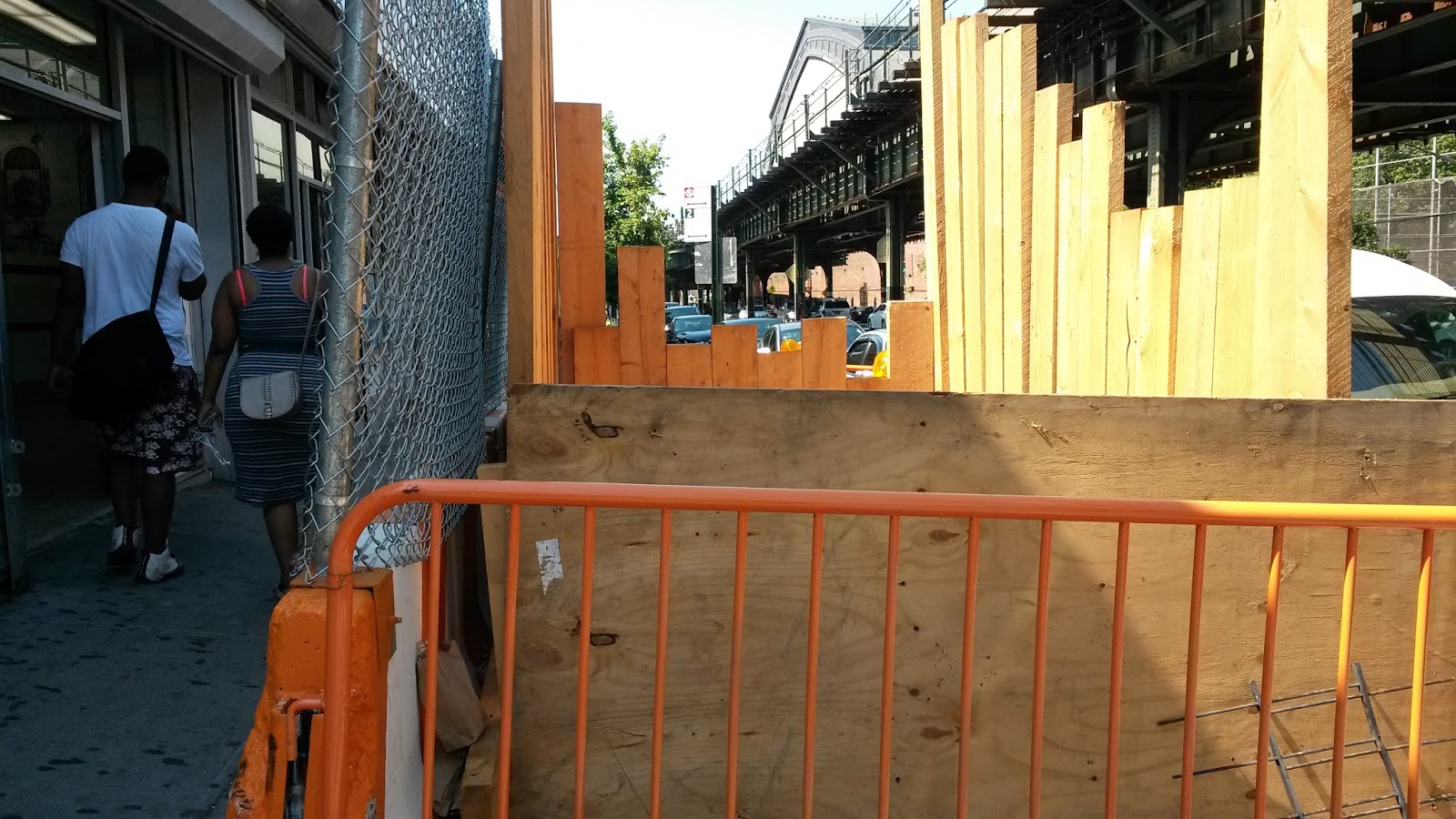
A miniature palisade suddenly rises. Natural wooden hues thrust upward from the sidewalk, warmly reflecting the summer sun. A few days later, it will be gone. This will once again be a regular stretch of sidewalk; the concrete will just be a little lighter gray.

Infrastructure projects often give rise to temporary streetscapes that can be as fantastical as they are disruptive. Consider this excavation site to repair an old pipe.


The design is entirely utilitarian. At the same time, it is coherent and creates a level of visual interest. The vertical lines of the rough-cut planks with irregular heights catch the eye and draw it down. 


The orange and white construction barriers, of various sorts, step out at a lower level, creating a layered space. It is reminiscent of a base or outer rampart. Constraining the sidewalk width accentuates the height of the planks.


On the intersection side, there is a plywood sheet that is slipped in and out to gain access to the pit. The taller passersby who are curious can get a view of the hole that has been dug out on the other side.


Within is a fleeting glimpse of a large, time-encrusted pipe. This is just one of innumerable pieces of infrastructure that have been invisibly running below our feet since long before we were born. All the busy activities we see in our daily lives share the street with these massive public works below. It makes you wonder about the possibilities of adding a little design effort to these temporary sites.


Friday, July 8, 2016

Concrete Marks

The urban ecosystem leaves concrete marks on our built environment. In some cases, the imprints of natural materials brought into the city are a deliberate design feature, like the exposed wood grain textures left by formwork on brutalist architecture. Other times, the flora and fauna that share the streets with us force themselves onto our constructions to leave their marks. These frozen traces of the fleeting nature we often overlook in our bustling lives can make spaces richer, more interesting places. They can make you stop and take notice, if only for a moment.


Monday, June 27, 2016

Angry Mobs

Yesterday evening, there was a loud bang outside our house. By the time my wife made it to the window, several cars were crashed and shouting people were surrounding one of the cars.

By the time I got down the steps, somebody had taken the keys from the driver. A shattered mess of debris had sprayed outward from the crash site. The passenger-side window was broken where a young man smashed it with his fist. It was immediately clear the driver was drunk. 

The drunk driver's car had come to a stop in front of our house, where it had destroyed the back of a double-parked car and crumpled it into a car parked in front of it. Another car with its driver-side mirror was parked behind it. The crowd growing around the car yelled about other cars the driver hit careening from one side to the other as he smashed his way down the street.

A boy and others from the corner showed up with a bent bicycle. Apparently he jumped off before the car crushed his bike down at the intersection.

People were growing increasingly angry. Another driver in particular was ready to drag the drunk out into the street for a public beating. He claimed to own the first car that was struck, and said he had followed the driver all the way from Westchester County, witnessing six or seven collisions along the way. It seemed like an overreaction for a broken mirror, although it was clearly infused with indignation over the state of the driver putting lives at risk on the road. Some of my neighbors were growing angrier as talk swirled about how easily he could have hit a child. The car he crushed where he came to a stop had a child seat in the back (but thankfully no child inside).

Saturday, May 28, 2016

Working the Street

The phrase "working the street" has referred to many things, but the connotations have mostly all been negative: prostitution, selling drugs, policing dangerous neighborhoods. Even after ideas espoused by Jane Jacobs seem to have become unshakable doctrines like "street life," an intractably negative view of the street still remains.

Nonetheless, the first introduction most children have to work and business skills still takes place on the sidewalk. Think lemonade stand. It's great learning experience, exposing them to planning, patience, customer service, and math, among other lessons that will serve them well in life (especially in a capitalist society).

For adult observers, a lemonade stand can also be a lesson in how a neighborhood works. Pedestrian activity and community cohesiveness affect the relative success of these budding ventures. The sheer number of potential customers in denser urban neighborhoods is an obvious advantage. Having more neighbors with a view from their window helps as well, since people often stop by to show their support for kids. Walking speed and face-to-face contact break down the barriers to stopping at a stand that sometimes limit interactions with neighbors driving by in the suburbs, as well.

Kids can get a great start by working the street, and places where people are generally walking by and friendly to one another offer the ingredients for a sweet little sidewalk stand.


Wednesday, April 27, 2016

Accidental Playspace between the Benches


When kids run and play, they like to experience different types of spaces. One particular place where I see kids playing year after year forms a type of space I rarely see in playground design. There is a gap between the backs of the benches facing in different direction, which looks at first like wasted, dead space. The kids really enjoy running through the series of long, narrow channels formed by these benches.

Sunday, April 24, 2016

When the Wealthy Steal Public Space

When the City allows a developer to construct a larger building in exchange for public space, you expect there to be a real benefit to the public. At the very least, you would expect the space to be minimally usable by the public. Nevertheless, at the Millenium Hilton Hotel, a "privately owned public space" is nothing more than a parking lot outside the hotel's garage, and it uses the public sidewalk as its driveway. As we will see, this is just a small part of a larger pattern of wealthy business owners padding their profits by stealing from the masses in New York City.


Of course, the privately owned public space at the Millenium Hilton is nothing short of a swindle. No space has been provided to ease pedestrian circulation. Instead, pedestrians remain confined to the original sidewalk, where they now have to contend with cars driving back and forth. Meanwhile, the private interests are able to eek out even more profit through the illicit revenue-generating use of this space.

There are unintended consequences, and there is negligence. It is not clear if this case quite crosses the line, but the City could clearly do much more to protect the public's interest in this property.