- See more at: http://www.bloggerhow.com/2012/07/implement-twitter-cards-blogger-blogspot.html/#sthash.DO2JBejM.dpuf

Saturday, January 18, 2014

Those Old-School Traffic Engineers

It has become popular to indict traffic engineers of yesteryear as men so determined to move cars more quickly they disregarded the safety of pedestrians just trying to get across the street alive. This criticism that they were anti-pedestrian is an uncharitable view. It ignores the historical record, unfairly excluding their deliberate attempts to improve pedestrian safety. So in the words of Al Smith: Let's look at the record.

To illustrate this, we don't have to look any further than the language commonly used to criticize the engineers who designed one-way streets decades ago. Consider this example, which is typical of comments made by many observers of streets (who are well intentioned and otherwise often well-informed):
The city's avenues were converted to one-way for one reason only: to give the city's driving elite priority over its walking majority.

Saturday, January 11, 2014

Building Ruins

It is our job as city builders to secure the funding necessary to build.  We cannot be frivolous, of course, but we must make the case for investment in infrastructure and architecture that lifts the soul.  Spending just enough to get by will be money wasted.  We will ultimately spend more as we return over and over again for repairs and minor functional improvements, and perhaps even an occasional beautification effort to address the worst of the ugliness, but we will never be satisfied.  There is no substitute for investing in quality.

We must be bold.  If we begin with the pessimism of limited funds, we will fail to produce the plans we need to carry us into the future.  Great plans will find investors, while weak incrementalism will only perpetuate stagnation.

If we are headed for ruin, let us at least leave ruins worth visiting.  Consider the great landmarks of civilization; some may be criticized for contributing to the financial collapse of those who built them, although I think that dubious.  There were invariably other, more critical structural problems that brought each institution to its demise.  The savings from forgoing their landmarks may have extended their life a little, but probably never could have saved them.  More significantly, the durability of landmarks has been a source of cultural and economic richness that accrues for generations beyond the measure of any discounted financial analysis.

As city builders, we owe a responsibility to the present and the future to produce quality landmarks. If we end in failure, let's make it the failure of ruins.


 Herman van Swanevelt (1603/1604–1655), via Wikimedia Commons

Sunday, January 5, 2014

"Sneckdowns"

@StreetsblogNYC pic.twitter.com/tpVZjqTk28
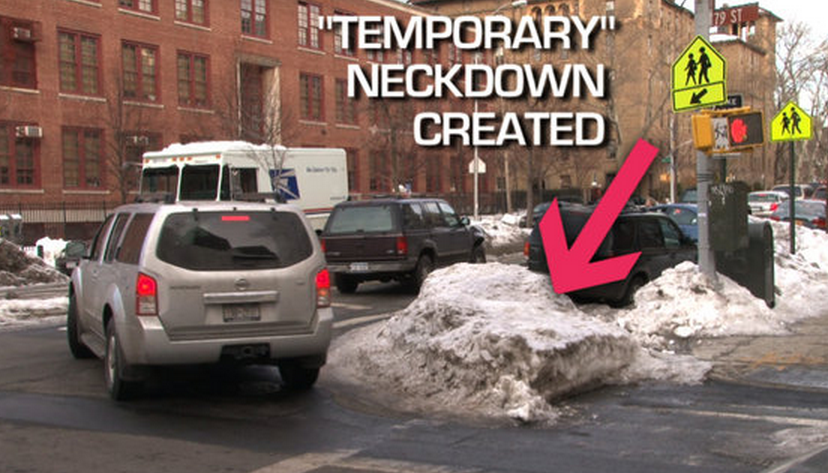
The #sneckdown tag has been trending on Twitter. The term is a clever combination of the words "snow" and "neckdown." The tag is used with photos of snow at intersections where it has not been cleared by vehicles, leaving areas that closely resemble neckdowns (see p. 74 of NYC DOT's Street Design Manual). As it is currently trending, these generally have an implicit or explicit claim of demonstrating that space is wasted by vehicles and could be used instead for traffic calming and pedestrian space.

I initially saw some discussions about "sneckdowns" last winter, with useful observations about how the snow piles were acting as temporary traffic calming. This winter, I noticed #sneckdown making the rounds at the first snowfall here in New York. Rather than discussing the temporary effects or snow plowing practices, the focus seemed to have shifted to claims that the areas that had not been cleared by vehicles should be converted into permanent neckdowns.

I found the original observations and discussions about snow plowing very useful. The observations about roadway space that wasn't actively used after the snowfall also initially struck me as something that might inspire a closer look at specific intersections. However, as the popularity of the #sneckdown tag grows and more people jump on the bandwagon with their own photos, I am becoming increasingly uncomfortable.

Friday, January 3, 2014

The Department of Buildings as Obstacle to Livable Streets

The New York City Department of Buildings (DOB) has been negligent in its responses to complaints for a long time. This can be critical when they continue to ignore complaints about illegal conversions that become fire traps for residents and firefighters.* DOB's failures to respond to complaints also causes problems for public streets and sidewalks that seriously erode quality of life in some neighborhoods, and can even become safety hazards in some instances.

Hopefully the new mayoral administration will address this problem. It is a clear example of the "Tale of Two Cities" narrative that de Blasio pressed while campaigning; nobody would believe that the City would ever tolerate somebody fencing off part of a public sidewalk to create a parking space on the Upper East Side, yet far too often the City has done nothing about it in places like The Bronx. Below are a few clear examples that illustrate the types of problems DOB has been ignoring that are destroying the livability of streets in some neighborhoods.


Public Sidewalks Appropriated for Private Parking

Despite repeat complaints about outrageous takings of public sidewalks to create illegal parking spaces, DOB has done nothing to correct the problems. Instead, the records show that inspectors dismissed the complaints with bogus reports.

Saturday, December 28, 2013

Paint the Town


Transportation engineers have long been painters, although the markings they have applied in white and yellow are not something anyone has ever recognized as artwork. Of course, they never intended for their functional markings to be a visual art (although their engineering work can be as much art as science at times). I find it interesting to note the pallet they use has been expanding in recent years, and our cities are gaining a little more colorful accent as a result. In some cases, transportation agencies are even using paint to create public art in places that have traditionally been mundane or outright unsightly.

Here's a quick rundown of the color pallet used for functional markings, a note about incorporating art to mitigate the unattractive spaces sometimes created by transportation, and some discussion of the limitations of paint.

Friday, December 20, 2013

Why One-Way Streets Work

The one-way operation on East 17th Street on the northern edge of Union Square allowed
NYC DOT planners to recapture space for a bike lane and new public space (photo NYC DOT)

One-way streets can provide many benefits for safety, sustainable transportation, and public space, when used properly under the right circumstances. Nevertheless, there are progressive advocates who believe that two-way streets are intrinsically superior. Their heart is in the right place in their effort to makes cities more livable, but I fear they are reaching the wrong conclusions because of an incorrect assumption and perhaps a bit too much nostalgia. This is an important issue for transportation and quality of life, so we should have some real discussion and communication.

This issue has been on my mind for some time, and a recent tweet by Brent Todarian brought it to the forefront:
One of the biggest city-making mistakes that continues to haunt & weaken downtowns is the abundance of one-way streets. .
From what I have seen, Todarian is a thoughtful planner with experience making substantive improvements in Vancouver. There are real limits to the complexity of an issue that can be conveyed in a tweet, so in all likelihood Toderian's thoughts have much more nuance. There are, however, vocal advocates who dogmatically take the position that one-way streets are fundamentally an anti-urban and illegitimate configuration.

Saturday, December 14, 2013

Speeding Past Schools During Alternate Side Parking

On a day off from work this week, I noticed something troubling about the New York Police Department's approach to enforcing Alternate Side Parking. Drivers were speeding past the local grade school, and it looked like the NYPD's methods were inadvertently contributing to the problem.

The New York Police Department generally allows double parking on the opposite side of the street during Alternate Side Parking for street cleaning. Nobody seems to really know or understand how this rule is supported in law, but it is generally observed and respected. There is a situation, however, where the NYPD does not allow this practice. You cannot double park on a block that has a school.

Supposedly there is some safety concern that motivates the NYPD to reign in the permissiveness around schools. If there is any effect, however, it quite likely makes the situation more dangerous. What I saw this week was cars absolutely flying down the block past the local grade school.

A typical NYC block, where double parking
is allowed during Alternate Side Parking
The next block over with a school, where double
parking isn't allowed. It encourages speeding

After a look around, the reason seemed obvious. Consider the blocks that allow double parking. The parking maintains a narrower effective width on the street, which helps discourage speeding. The blocks with schools, however, create wide open roads where drivers feel comfortable stepping on the gas.

Since the NYPD is clearly comfortable allowing the widespread practice of double parking during Alternate Side Parking, they should reevaluate their strict enforcement on blocks with schools. These may be the locations where double parking may actually be most appropriate.